
WHAT WE LEARNED IN SEPTEMBER
Here is a typical day in September: Oil up, bond yields up, stocks down. At first glance, the link between higher oil and higher Treasury yields seems obvious, and Fed Chairman Warsh and his committee concluded it had to respond. So higher oil means higher short-term rates. It is less clear how higher oil prices should affect longer-term yields on bonds.
Higher oil prices are a one-off. Higher prices lift inflation only once. Once oil stops going up, its direct impact on inflation disappears. And if oil gets so expensive it hurts the economy, high oil prices would reduce non-oil inflation.
Now let’s look at what we learned in September …
The U.S. economy remains strong with consumers spending aggressively and final demand holding up. Consumers are spending at a 6% nominal clip. Q3 is tracking at 5%, an impressive number given the various headwinds from oil prices to high mortgage rates. We see no reason that strong growth will slow near-term, although we know the cyclical upturn will not last forever. The Fed may see upside risks to GDP forecasts and feel the need to raise its estimate of the neutral rate. Are soaring long-term rates due to strong growth fundamentals and less about inflation? We think so.
Labor markets appear strong. Initial jobless claims are running far below recent years and continue to improve. This trend is backed up by private sector data.
The fundamental technology improvement that supports the AI boom in markets and capex is still intact and remains a positive catalyst. With the capex cycle intact, expect the AI narrative to continue. The AI capex boom is drawing in shocking amounts of capital. Investment grade corporate bond issuance alone is tracking over $2.2 trillion this year. And while AI will likely raise productivity, no such acceleration is visible in the data … yet.
Despite appreciation in share prices this year, the S&P 500 forward 12-month P/E multiple has dropped and is back in the high teens (down from 23x). We don’t consider this cheap but instead reasonable given the fundamental backdrop. We understand stock market bubbles can be in earnings rather than Earnings are currently exploding. According to FactSet, S&P 500 earnings are expected to grow 31.8% this year and 15.2% in 2027. Profit margins have smashed all prior records. The graph below shows profits as a percentage of national income going back 80 years:
CORPORATE PROFITS TAKE A RECORD SHARE OF NATIONAL INCOME
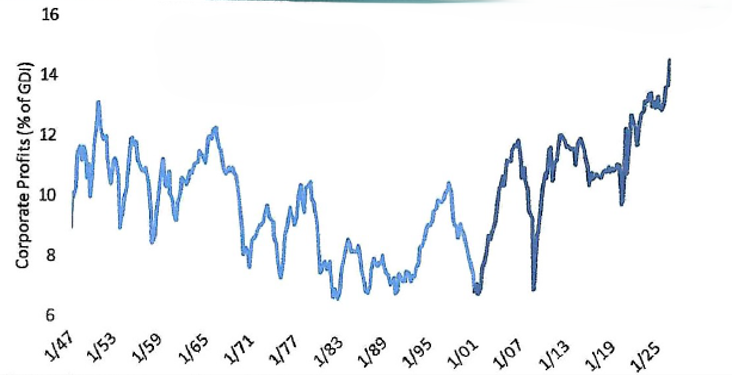
Source: Bespoke Investment Group.
Current investor sentiment is awful. Investors don’t like what they see based on weekly American Association of Individual Investors (AAII) sentiment numbers. Bearish sentiment crossed back above 50%, its highest level since the 2025 tariff tantrum. Bullish sentiment dipped below 30%. This contrarian signal is flashing green. Equity funds have now seen four consecutive weeks of outflows.
——————————————-
The broader market has been struggling while cap-weighted indexes are inching higher. The equal-weighted S&P 500 index has fallen for six consecutive weeks, and is now down more than 5% from its August peak. The one bright spot over the last month has been tech, especially the Mag 7. For this bull market to start firing on all cylinders again, semis and transports need to break out of their downtrends along with participation from the broader market. Short-term weakness has a way of shaking investors out just when they should be hanging tight. The market usually rewards the most patient investors.