
A few final comments on this earnings season: This week’s Walmart’s earnings report marks the unofficial end to the season. It was a season for the record books. For the second quarter, S&P 500 companies are reporting year-over-year growth in earnings of 50% (32% ex-Alphabet and Amazon) and 15% growth in revenues. For all of 2026, analysts are expecting earnings growth of about 30% and add another 13% in 2027 (source: FactSet). Since share prices track earnings over time, this is music to our ears – and every other bullish investor.
A whopping 15% of companies have raised guidance this quarter which is the second highest reading in the last 20 years, behind only the surge coming out of Covid.
Rapid earnings growth helped forward P/E multiples come down 3x since last October despite new record highs in stocks. Stocks are not dirt cheap but are certainly not extreme. The forward twelve-month P/E ratio has been cut to 19x, about in line with both the S&P 500’s five-year and 10-year average.
Long-term U.S. Treasury bonds (10-year maturities and longer) are often used in balanced accounts to help with capital preservation and to provide income. This is what all of us learned in Investments 101.
What we can say though is that long-term Treasuries have turned into one of the least safe assets relative to most other traditional assets. Imagine putting money into “safe” long-term Treasuries five years ago to keep it secure and being down close to 20% today! That is the actual number (source: Bespoke).
Of course, the reason for the dismal performance is that interest rates have risen substantially in the last five years. When interest rates rise, bond prices fall. And the longer the bond maturity, the greater the volatility.
What should balanced account investors do to avoid this painful situation? In our client portfolios, we avoid long-term maturity bonds and stick with short-term bonds. As a result, we give up a little income (yield) but principal is much more stable as a result. Our philosophy is that risks should be taken in stocks not bonds. Bond portfolios should be kept safe. Short-term bonds are much less volatile as interest rates increase (or decrease).
AUGUST RALLY
At the end of our last commentary, we listed three things we thought the stock market needed to end the June-July doldrums: a strong earnings season, a Fed on hold, and an easing in oil prices. We got all three. Sure enough, stocks have rebounded so far in August with the S&P 500 up about 4% MTD through yesterday.
The major stock market indexes are at or near all-time highs. Some, like the S&P 500, are overbought in the short-term which simply means prices have risen sharply in a short time frame and need a breather. Market breadth remains positive – a very good sign. The cumulative advance-decline line is making new highs along with stocks. See graph below:
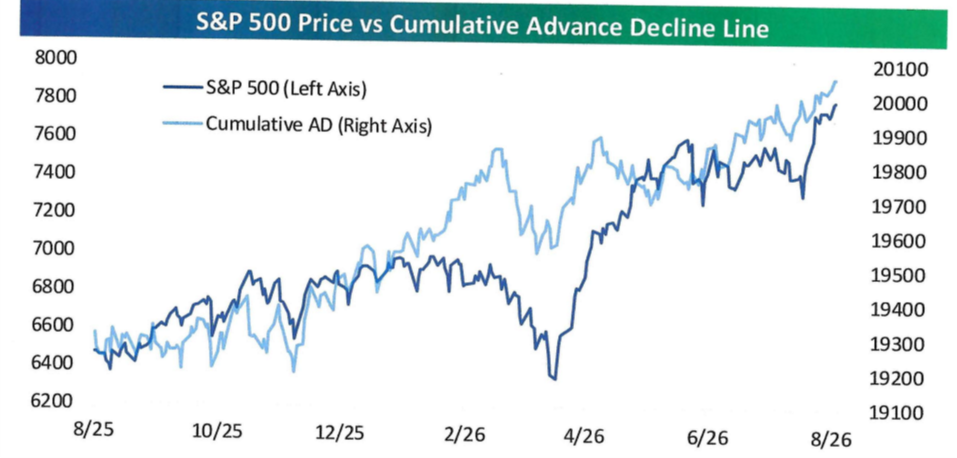
Source: Bespoke Investment Group
Sentiment is not overly bullish. Call it mixed. Bears still outnumber bulls which is encouraging (contrarian indicator). However, the Schwab Trading Activity Index is showing some complacency among investors. This index tracks what investors are actually doing, not asking investors their view on the market.
The driving theme of this bull market remains AI and is intact. The AI buildout outlook is stronger than ever. Consensus hyperscaler capex forecasts continue to rise. Until spending from these key companies slows dramatically, the boom should continue. The consensus forecasts don’t foresee a slowdown coming until 2028 or later. We think investors should be looking at the long-term potential of AI and not be paralyzed by the bears’ cry of too much debt financing. In aggregate the corporate sector is still spending less on capex than its aggregate cash flow. Typically, the corporate sector invests more than cashflow as an economic cycle progresses, eventually leading to over-leveraging and a recession. The opposite is true today.