Both stock prices and market breadth peaked a month ago. It has been a tough slog since.  The broader market has been trailing mega-caps which are holding up nicely.  The 10-day advance/decline line drop has been dramatic as well as other breadth measures.

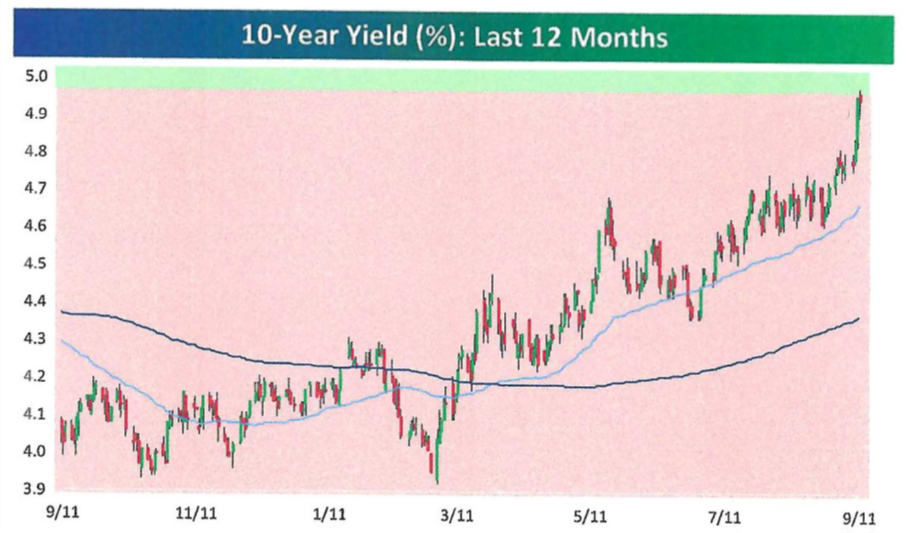
The culprit for the weakness comes down to two words – oil and rates.  Until crude oil and yields start to fall, it will be hard for equities to see a meaningful rally from here.  Just look at the huge increases in both factors over the last twelve months.  No wonder stocks have been weak lately:
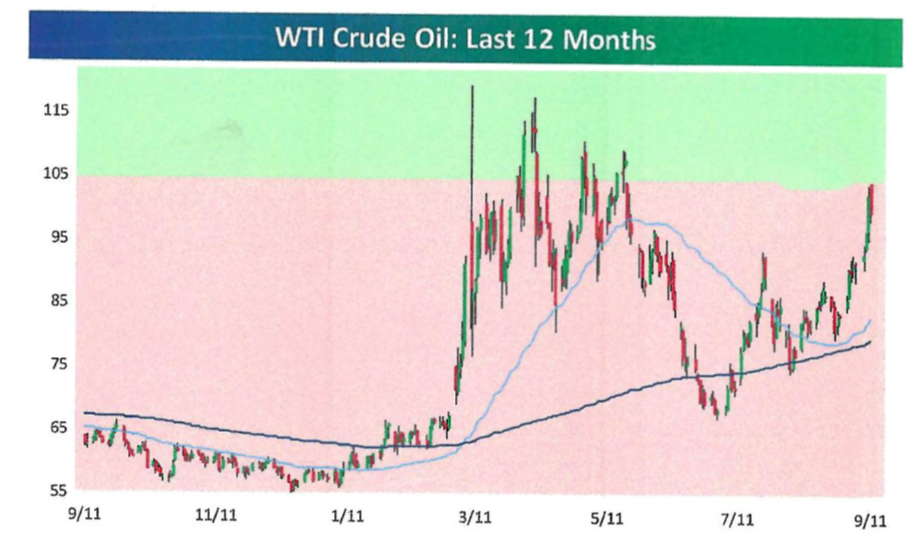
Source:  Bespoke Investment Group

Tomorrow’s Fed rate announcement is key for investors.  A hike would show that Fed Chairman Warsh is serious about taming inflation.  If, on the other hand, Warsh shies away from a hike after his vows last month to make high inflation a “thing of the past,” it could suggest he is all talk.

Current monetary conditions are far from restrictive.  With both the economy and labor markets showing welcome resilience, getting inflation down should be the top priority for the Fed.  We expect a rate hike tomorrow along with many other investors (a rate hike is now priced at 87%).

Bulls say this is a necessary tap on the brakes.  Bears say this is the start of a larger rate hiking cycle.  Only time will tell.  Our thinking is this depends largely on the trajectory of oil prices.  A Fed rate hike should bolster stability, quiet the fears of runaway inflation, and allow stocks to get back and focus on what really matters:  the AI buildout and the earnings bonanza it continues to precipitate.  The more investors focus on that, the better the market will do.

WHY HIGHER INTEREST RATES HURT STOCK PRICES

As we mentioned in the bullet point above, higher interest rates are one of the primary reasons stocks have had a tough go of it lately.  And under the surface of the index levels, numerous stocks are undergoing their own corrections – some are down 10-20% in the last few months.  Quality stocks are actually underperforming lesser quality ones.

As interest rates continue to rise, stocks will have a hard time resuming their bull market ways.  We present four main reasons rising rates may continue to be a headwind for stocks:

  • Slowed consumer spending. Higher rates make loans, including mortgages, more expensive for consumers.  People buy fewer homes, cars, and large appliances.  Lower consumer demand hurts business revenue and profits.
  • Higher borrowing costs for businesses. Companies borrow money to fund and grow their businesses.  Higher interest rates increase debt payments.  This is especially painful for smaller companies that often use short-term floating-rate debt on their balance sheets.  Debt payments are now going up in lock step with higher short-term rates.  Higher expenses cut into company profits which can lead to lower stock prices.  One of the two major catalysts for this phase of the bull market is exploding profit growth (the other is AI adoption).  Bears ask how much will higher rates slow profit growth?
  • Competition from bonds. Safer assets like bonds and CDs pay higher interest when rates are high.  Right now the spread between dividend yields (the S&P 500 now yields under 1%) and bond rates (the 10-year maturity government bond yield is about 5.0%) is the highest it has been since the 1990s.  But bulls correctly point out that this spread was even more unattractive through much of the 1990s, but that didn’t stop stocks from rallying the entire decade.  However, common sense tells us that new investor money may go into bonds.
  • Lower stock valuations. Stock prices depend on future profits.  Investors use a “discount rate” (or interest rate) to determine what those future profits are worth today.  A higher discount rate means future earnings are worth less today.  This may cause stock prices to drop.

In summary, we see the bull market on “pause” as rates continue to climb.  Tomorrow’s Fed rate decision is important.  A rate hike could give the bond market confidence that the Fed will do what it takes to tame inflation which has now been above-trend for five years.  A stable bond market could also help stocks stabilize.

Knowledge – Results

Experts in Risk Management

Are you prepared for the next market correction or financial crisis?

Knowledge – Results

Experts in Risk Management

Are you prepared for the next market correction or financial crisis?

Knowledge – Results

Experts in Risk Management

Are you prepared for the next market correction or financial crisis?

Knowledge – Results

Experts in Risk Management

Are you prepared for the next market correction or financial crisis?

Real Retirement Solutions

designed to improve
  • Wealth Preservation
  • Management of Risky Assets
  • Peace of Mind

This is achieved through an ongoing assessment of market risks given your specific financial situation and goals.

Get Started

Professional Expertise

Leadership Team

Richard Furmanski

Richard Furmanski

CFA

has been a portfolio manager and analyst for over 35 years. He manages conservative, tax-efficient portfolios for both pre-retirees and retirees. His lower risk approach appeals to investors who want less volatility and competitive risk-adjusted returns.

View full bio

Mary Ellen Adam

Mary Ellen Adam

Director of Operations

has been in office administration for over twenty years. Her experience includes customer service, firm operations, and office administration. She interacts with our clients on a day-to-day basis and handles any requests that may arise.

View full bio

Frequently Asked Questions

If you can't find the answer to your questions here, feel free to give us a call at 847-847-2505

Do you manage both stock and bond portfolios?

Yes. We build a portfolio of conservative, high-quality stocks and hold them for the long-term. The average holding period is 4 – 5 years. Our focus is on stocks that are suitable for retirement portfolios.

Our high-quality bond portfolios are designed to provide both income and stability of principal. Bonds provide the anchor for balanced accounts (those holding both stocks and bonds).

What is your investment philosophy?
We take great care in purchasing only high-quality stocks and bonds intent on a multi-year holding period. Portfolio turnover and taxable realized gains are modest in comparison to other active managers. We do not time the market but will become more defensive, in terms of stock holdings, when market conditions warrant.
Will the portfolio be managed in accordance with my financial goals?
Yes. Each of our clients has a custom-tailored portfolio. These custom portfolios are designed to meet specific client objectives with a thoughtful approach to specific constraints such as risk tolerance. And as each client’s situation changes, the portfolio does as well. There is no cookie cutter approach.
What kind of expertise do you have and how can that help me in difficult markets?
We have been working with high-net-worth clients like you since 1982. Over that time we have helped them to navigate several bear markets and financial crises (including the stock market crash of 1987). We hold the Chartered Financial Analyst (CFA) and Certified Financial Planner (CFP) designations.
Are you sensitive to taxes when managing portfolios?
Yes. Our holding period for an individual stock averages 4 plus years which means our turnover is low and realized gains can be carefully managed. Further, where possible, we tax loss harvest small losses as a way of offsetting gains taken elsewhere in the portfolio.
How have you performed?
Results will differ by client and the level of customization but we have provided competitive investment returns for many years.
How do you charge for your services?
We charge a management or consultant fee based upon the size and level of customization of the account. As the account grows, we benefit together.

Recent Commentaries

Stay up to date with all of our latest comments and analysis.

October 2026 Market Commentary

WHAT WE LEARNED IN SEPTEMBER Here is a typical day in September:  Oil up, bond yields up, stocks down.  At first...

September 2026 Market Commentary

WILL HIGHER INTEREST RATES BE A BULL-BUSTER? Long-term bond yields are going up around the globe.  The countries affected have a wide variety of fiscal backdrops and central bank policy rates suggesting the cause is something other than a deficit or a signal from a...

August 2026 Market Commentary

We got very good news on the inflation front a couple of weeks ago (CPI and PPI reports) that sent rate hike odds for this week’s Fed meeting down to near 0%. However, over the last week we have seen a sharp pick-up in the odds of a rate hike as oil prices have spiked...

July 2026 Market Commentary

THE LAG SEVEN   The “Magnificent 7” stocks (Amazon, Apple, Microsoft, Alphabet, Meta Platforms, Nvidia and Tesla) led the stock market’s gains in 2023, 2024 and part of 2025. These same stocks as a group are lagging badly in 2026, and put into question whether...

Monthly Updates

August 2026 Mid-Month Recap

A few final comments on this earnings season: This week’s Walmart’s earnings report marks the unofficial end to the season.  It was a season for the record books.  For the second quarter, S&P 500 companies are reporting year-over-year growth in earnings of 50%...

July 2026 Mid-Month Recap

Coming into earnings season this week, the pace of positive earnings revisions has skewed higher which raises the expectations bar. The market’s performance during earnings season tends to be inversely correlated to the direction of earnings revisions heading into the...

As a current or near term retiree you have real concerns…

We provide dedicated solutions
Contact Us