
WILL HIGHER INTEREST RATES BE A BULL-BUSTER?

Long-term bond yields are going up around the globe.  The countries affected have a wide variety of fiscal backdrops and central bank policy rates suggesting the cause is something other than a deficit or a signal from a central bank’s recent policy.  In the U.S., the entire yield curve is shifting upward (all maturity lengths).  As shown below, the yield on the 10-year U.S. Treasury is up substantially this year:
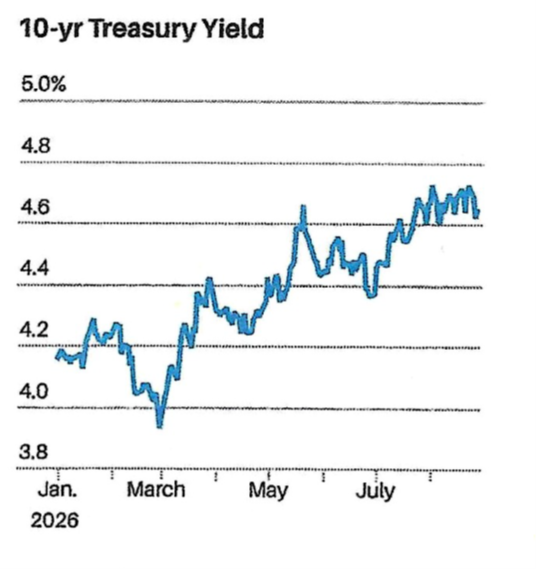
Source:  Bloomberg

What is going on?  The sharp rise in yields here in the U.S. has sparked a wave of explanations including:

  • Resilient U.S. economic growth around the 2% level on an annualized basis. Or might growth be accelerating because of the AI capex boom?
  • Sticky inflation. Last month’s CPI, PPI and PCE inflation measures all point to inflation above the Fed’s long-term goal of 2%.  Inflation is stuck around the 3% level and has been a problem now for about five years.
  • Fiscal concerns. Last week the gross U.S. debt surpassed a record $40 trillion.  The federal debt has ballooned to 100% of GDP from 32% in 2008.  When is the day of reckoning?
  • Fed credibility questions. A failure to hike rates in the absence of declines in either inflation or payroll growth could threaten Fed credibility.  This has been a market concern since Mr. Warsh became Fed Chairman.  This is a bit odd to us as Warsh is seen as the most hawkish central banker since Volcker.  Yet the market still questions whether Kevin Warsh is too dovish – or is he looking for excuses to be more dovish?  He certainly didn’t sound that way last Friday at Jackson Hole.  The key line about the upcoming September Fed meeting: “While this summer’s PCE and CPI readings were better than expected, they do not tell me that underlying trends have meaningfully improved . . .  We must be confident that underlying inflation is moving to our objective, clearly and at sufficient speed.  Otherwise, we have work to do.”  The “work to do” is clearly a reference to tightening.  But the markets are still not fully convinced the Fed will deliver.  Market odds of a tightening in September only rose to 57.1% after his speech (up from 35.8%).  We would place the odds higher than 57% after his clear warnings. 
  • AI investment. Is the boom in AI capex investment crowding out other borrowers and pushing rates up?  After all, the five largest hyperscalers had already issued $159 billion in bonds by mid-2026, surpassing the entirety of 2025.

Those are five powerful reasons for interest rates to rise.  The key question for investors to ask:  Is this a short-term phenomenon (cyclical) or long-term (structural)?  Our take is that this is structural and a return to normal levels.  Apparently “rout” is the new word for interest rates returning to a historical norm.  The low-rate era following the 2008 financial panic is over, in our view.  Borrowers of all kinds will have to adjust – not least the Western governments that have spent and borrowed as if near-zero interest rates would last forever.  For businesses, rising yields mean higher borrowing costs.  For the public, rising Treasury yields could mean paying higher rates on auto loans, mortgages and other loans.  In conclusion, the markets seem to be managing an adjustment to rates rather than anticipating a significant new hiking cycle. 

Can the stock market handle higher interest rates?  We think so.  After all, the historical record of stock returns when interest rates were higher (“normal”) is strong.  Both the economy and markets will have to adjust to their old pre-2008 ways but it doesn’t mean the bull market in stocks must end.  However, it may slow down future gains because higher interest rates mean equilibrium valuation levels for stocks may be lower. 

Higher interest rates also mean revisions to our equity strategy.  For example:  Since higher interest rates affect valuations more on longer duration stocks (growth stocks), value stocks become more attractive on a relative basis.  In fact, value stocks have outperformed growth since interest rates started rising.  We expect this to continue.  Our focus on new purchases is now tilted to value stocks, including dividend stocks.  Also, smaller companies often have floating rate debt.  The increase in debt cost may slow down earnings growth going forward for this group.  Bigger is better.

Knowledge – Results

Experts in Risk Management

Are you prepared for the next market correction or financial crisis?

Knowledge – Results

Experts in Risk Management

Are you prepared for the next market correction or financial crisis?

Knowledge – Results

Experts in Risk Management

Are you prepared for the next market correction or financial crisis?

Knowledge – Results

Experts in Risk Management

Are you prepared for the next market correction or financial crisis?

Real Retirement Solutions

designed to improve
  • Wealth Preservation
  • Management of Risky Assets
  • Peace of Mind

This is achieved through an ongoing assessment of market risks given your specific financial situation and goals.

Get Started

Professional Expertise

Leadership Team

Richard Furmanski

Richard Furmanski

CFA

has been a portfolio manager and analyst for over 35 years. He manages conservative, tax-efficient portfolios for both pre-retirees and retirees. His lower risk approach appeals to investors who want less volatility and competitive risk-adjusted returns.

View full bio

Mary Ellen Adam

Mary Ellen Adam

Director of Operations

has been in office administration for over twenty years. Her experience includes customer service, firm operations, and office administration. She interacts with our clients on a day-to-day basis and handles any requests that may arise.

View full bio

Frequently Asked Questions

If you can't find the answer to your questions here, feel free to give us a call at 847-847-2505

Do you manage both stock and bond portfolios?

Yes. We build a portfolio of conservative, high-quality stocks and hold them for the long-term. The average holding period is 4 – 5 years. Our focus is on stocks that are suitable for retirement portfolios.

Our high-quality bond portfolios are designed to provide both income and stability of principal. Bonds provide the anchor for balanced accounts (those holding both stocks and bonds).

What is your investment philosophy?
We take great care in purchasing only high-quality stocks and bonds intent on a multi-year holding period. Portfolio turnover and taxable realized gains are modest in comparison to other active managers. We do not time the market but will become more defensive, in terms of stock holdings, when market conditions warrant.
Will the portfolio be managed in accordance with my financial goals?
Yes. Each of our clients has a custom-tailored portfolio. These custom portfolios are designed to meet specific client objectives with a thoughtful approach to specific constraints such as risk tolerance. And as each client’s situation changes, the portfolio does as well. There is no cookie cutter approach.
What kind of expertise do you have and how can that help me in difficult markets?
We have been working with high-net-worth clients like you since 1982. Over that time we have helped them to navigate several bear markets and financial crises (including the stock market crash of 1987). We hold the Chartered Financial Analyst (CFA) and Certified Financial Planner (CFP) designations.
Are you sensitive to taxes when managing portfolios?
Yes. Our holding period for an individual stock averages 4 plus years which means our turnover is low and realized gains can be carefully managed. Further, where possible, we tax loss harvest small losses as a way of offsetting gains taken elsewhere in the portfolio.
How have you performed?
Results will differ by client and the level of customization but we have provided competitive investment returns for many years.
How do you charge for your services?
We charge a management or consultant fee based upon the size and level of customization of the account. As the account grows, we benefit together.

Recent Commentaries

Stay up to date with all of our latest comments and analysis.

October 2026 Market Commentary

WHAT WE LEARNED IN SEPTEMBER Here is a typical day in September:  Oil up, bond yields up, stocks down.  At first...

August 2026 Market Commentary

We got very good news on the inflation front a couple of weeks ago (CPI and PPI reports) that sent rate hike odds for this week’s Fed meeting down to near 0%. However, over the last week we have seen a sharp pick-up in the odds of a rate hike as oil prices have spiked...

July 2026 Market Commentary

THE LAG SEVEN   The “Magnificent 7” stocks (Amazon, Apple, Microsoft, Alphabet, Meta Platforms, Nvidia and Tesla) led the stock market’s gains in 2023, 2024 and part of 2025. These same stocks as a group are lagging badly in 2026, and put into question whether...

June 2026 Market Commentary

WARNING SIGNS FOR THE U.S. BULL MARKET On occasion we are told we are overly optimistic investors – maybe even perma-bulls.  We are not perma-bulls but do tend to be very optimistic.  Our position remains that optimistic investors do better than pessimists.  After...

Monthly Updates

September 2026 Mid-Month Recap

Both stock prices and market breadth peaked a month ago. It has been a tough slog since.  The broader market has been trailing mega-caps which are holding up nicely.  The 10-day advance/decline line drop has been dramatic as well as other breadth measures. The culprit...

August 2026 Mid-Month Recap

A few final comments on this earnings season: This week’s Walmart’s earnings report marks the unofficial end to the season.  It was a season for the record books.  For the second quarter, S&P 500 companies are reporting year-over-year growth in earnings of 50%...

As a current or near term retiree you have real concerns…

We provide dedicated solutions
Contact Us