
Q and A


The stock market’s meteoric rise since March 30 is raising questions from clients.  Let’s start with the most asked question:

Q.  Since the Iran conflict started, oil prices are higher along with higher inflation and interest rates. How can the market rally when these factors point to potential trouble ahead?

A.  We are stuck between a closed Strait and an AI boom. It is abundantly clear which one of those is winning at the moment, as markets continue to notch new all-time highs on the back of a stunning AI and tech-fueled run in equity markets.

Over the longer-term, earnings drive stock prices.  It is as simple as that.  You could even say that profits are the lifeblood of our capitalistic system.  Growing corporate earnings have provided fuel for this entire bull market.

The growth in corporate earnings we are seeing now is extraordinary.  On March 31 coming into the Q1 earnings season the expected growth for S&P 500 profits was 13.1% year-over-year – an excellent number.  Actual earnings growth will come in at about 27% (this is not a typo).  This is incredible.  Earnings growth for calendar 2026 is expected to be 20.6% (all earnings figures are from FactSet).  You could say earnings from the AI boom are responsible for the latest mega-rally in stock prices.

Other positive factors aiding the rally include unexpected jobs growth in non-farm payrolls the last two months surpassing forecasts by a wide margin.  And GDP growth is fine – neither reaccelerating nor collapsing.  Is this “ho-hum” economy good enough for markets to continue pushing higher?  We think so (with caveats described in the answer to the next question).

Q.  Has the recent stock market rally been solid or does it look like a potential bubble?

A.  The most recent rally in stocks has not been as broad as we would like. The bulk of the market’s move to new highs has been driven by a small number of stocks in Tech, including semis.  Bulls argue that the rest of the index will eventually catch up.

The S&P 500’s cumulative advance/decline line remains well below prior highs as the index surged to new records last week.  See the graph below.  Notice the spike higher in S&P 500 prices along with a declining A/D line:
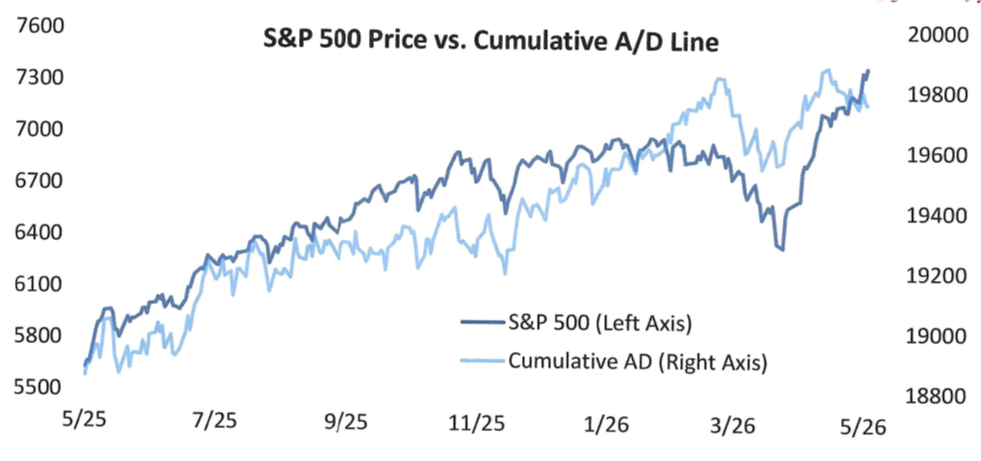
Source:  Bespoke Investment Group

Another technical breadth indicator, moving averages, also looks sketchy.  If you were to look at the percentage of stocks trading above their 50- and 200-day moving averages, it would be hard to tell the market has set records.  This is not to say these breadth measures can’t catch up with prices, but for now we think breadth needs to improve for the market to have another leg up from here.

Are we in a bubble?  After all, semiconductor stocks rose 38% in April.  Are investors getting giddy with stock gains?

Spotting a bubble is harder than it seems.  If investors could identify a bubble, it probably wouldn’t form in the first place.  Investors would see it begin to form and promptly step aside or bet against it.  Over-pricing in parts of the market does not constitute a bubble.

One historical sign of a bubble is a tidal wave of stocks issuance like the late 1990s or even 2020-2021 (SPACs).  So far at least, new stock offerings haven’t flooded the market.

Another sign of a bubble is performance chasing behavior.  Momentum investing dominates.  However, we are seeing contrarian, not performance chasing, behavior.  A bubble is buy the rip, not buy the dip.

In our humble opinion on bubbles, we are not in one.

Q.  A number of respected Wall Street economists are expecting a U.S. recession by the end of this year. Could this happen?

A.  Anything is possible but we don’t see it.

Bears on the economy point to …


  • Housing market stagnation which has represented a drag on GDP growth for seven of the past eight quarters.  Housing is a big part of our economy.
  • The possibility of a weaker jobs market. Low-hire low-fire won’t last.
  • Higher inflation combined with lower economic growth resulting in stagflation or worse.
  • A tighter Fed or at least one where cuts later this year are off the table. Our view is that raising interest rates would act like a ‘tax’ on consumers on top of the higher oil price ‘tax.’  We don’t expect this to happen.  But will the Fed cut rates any time soon?  Not likely in our view.
Knowledge – Results

Experts in Risk Management

Are you prepared for the next market correction or financial crisis?

Knowledge – Results

Experts in Risk Management

Are you prepared for the next market correction or financial crisis?

Knowledge – Results

Experts in Risk Management

Are you prepared for the next market correction or financial crisis?

Knowledge – Results

Experts in Risk Management

Are you prepared for the next market correction or financial crisis?

Real Retirement Solutions

designed to improve
  • Wealth Preservation
  • Management of Risky Assets
  • Peace of Mind

This is achieved through an ongoing assessment of market risks given your specific financial situation and goals.

Get Started

Professional Expertise

Leadership Team

Richard Furmanski

Richard Furmanski

CFA

has been a portfolio manager and analyst for over 35 years. He manages conservative, tax-efficient portfolios for both pre-retirees and retirees. His lower risk approach appeals to investors who want less volatility and competitive risk-adjusted returns.

View full bio

Mary Ellen Adam

Mary Ellen Adam

Director of Operations

has been in office administration for over twenty years. Her experience includes customer service, firm operations, and office administration. She interacts with our clients on a day-to-day basis and handles any requests that may arise.

View full bio

Frequently Asked Questions

If you can't find the answer to your questions here, feel free to give us a call at 847-847-2505

Do you manage both stock and bond portfolios?

Yes. We build a portfolio of conservative, high-quality stocks and hold them for the long-term. The average holding period is 4 – 5 years. Our focus is on stocks that are suitable for retirement portfolios.

Our high-quality bond portfolios are designed to provide both income and stability of principal. Bonds provide the anchor for balanced accounts (those holding both stocks and bonds).

What is your investment philosophy?
We take great care in purchasing only high-quality stocks and bonds intent on a multi-year holding period. Portfolio turnover and taxable realized gains are modest in comparison to other active managers. We do not time the market but will become more defensive, in terms of stock holdings, when market conditions warrant.
Will the portfolio be managed in accordance with my financial goals?
Yes. Each of our clients has a custom-tailored portfolio. These custom portfolios are designed to meet specific client objectives with a thoughtful approach to specific constraints such as risk tolerance. And as each client’s situation changes, the portfolio does as well. There is no cookie cutter approach.
What kind of expertise do you have and how can that help me in difficult markets?
We have been working with high-net-worth clients like you since 1982. Over that time we have helped them to navigate several bear markets and financial crises (including the stock market crash of 1987). We hold the Chartered Financial Analyst (CFA) and Certified Financial Planner (CFP) designations.
Are you sensitive to taxes when managing portfolios?
Yes. Our holding period for an individual stock averages 4 plus years which means our turnover is low and realized gains can be carefully managed. Further, where possible, we tax loss harvest small losses as a way of offsetting gains taken elsewhere in the portfolio.
How have you performed?
Results will differ by client and the level of customization but we have provided competitive investment returns for many years.
How do you charge for your services?
We charge a management or consultant fee based upon the size and level of customization of the account. As the account grows, we benefit together.

Recent Commentaries

Stay up to date with all of our latest comments and analysis.

May 2026 Market Commentary

THE RALLY CONTINUES:  ODDS AND ENDS The rally in the S&P 500 continues and is up 13% since March 30 - and over 15%...

April 2026 Market Commentary

EARNINGS DRIVE STOCKS, NOT HEADLINES The drawdown in stocks has been accelerating since our last commentary.  Through yesterday the S&P 500 is down 7.3% YTD and Nasdaq 10.5%.  The average stock in the S&P 500 is down over 20% since the market peak late last...

February 2026 Market Commentary

January was a battle between high quality stocks and lower quality stocks. Lower quality stocks won.  That includes small and micro caps.  (Our view is that the primary small cap stock index, the Russell 2000, is a low-quality index.  About 40% of stocks in the index...

January 2026 Market Commentary

THE INVESTMENT LANDSCAPE FOR 2026 Happy New Year!  The beginning of a new year is as good a time as any to take an inventory of important variables affecting investors and to see what the investment landscape looks like.  The summary below attempts to do just that....

Monthly Updates

April 2026 Mid-Month Recap

If you find that your portfolio’s investment returns are dominated by a small handful of stocks, you are not alone. We have experienced the same thing. Burton Malkiel (renowned author of the classic “A Random Walk Down Wall Street”) did a recent study about this...

March 2026 Mid-Month Recap

In January we wrote the “three-headed monster” (courtesy of Bespoke Investment Group) was flashing green. The three variables – oil, Treasury yields, and the dollar – were all in downtrends which bodes well for stocks.  In the last three weeks we have seen a massive...

As a current or near term retiree you have real concerns…

We provide dedicated solutions
Contact Us