
Today is election day. While the outcomes of the elections are not a foregone conclusion, bettors on prediction market Kalshi give the Democrats a 90% chance of taking control of the House and a 63% shot at the Senate. Wall Street generally prefers a divided Washington. They apparently think there is less of a chance of bad policy being passed when power is split. Investors shouldn’t confuse legislative paralysis with political tranquility. Some industries will inevitably find themselves in the crosshairs.
As you probably already know, since WWII, the pre-Presidential election year (2027) has been the strongest of the four years. In fact, the S&P 500, including dividends, hasn’t experienced a negative pre-Presidential election year since the 1930s. Many attribute this strength to policymakers’ tendency to support economic growth heading into an election year. And since 1930, midterms resulting in a Republican president and Democratic congress have produced average S&P 500 gains of 13% in the twelve months following the election. So the bulls have this going for them next year.
We are now three full weeks into earning season with the S&P 500 down 3.5% over this timeframe. On balance, most companies are reporting good results in line with lofty expectations, but it isn’t mattering much to stock prices which have often fallen in response to solid numbers. Even triple plays have been net down this quarter which is both surprising and troubling. This market has become an earnings led bull market so what does this price action tell us? Bears say we are in an earnings bubble with peak earnings not too far ahead of us. Are they right? We don’t think so. But it is shocking to see the shares of trillion-dollar market cap companies move 10% in a day (up or down). Valuations of these companies shouldn’t change that much based on just a slight miss or beat to earnings forecasts. But this is the market we are in. As long-term investors it is important for us not to overreact to these extreme swings in market value and share prices. Rather, we try to take advantage of sell-offs based on investor emotions.
The (contrarian) CNN Fear and Greed Index seems to be in a perpetual “Fear” state. See below:
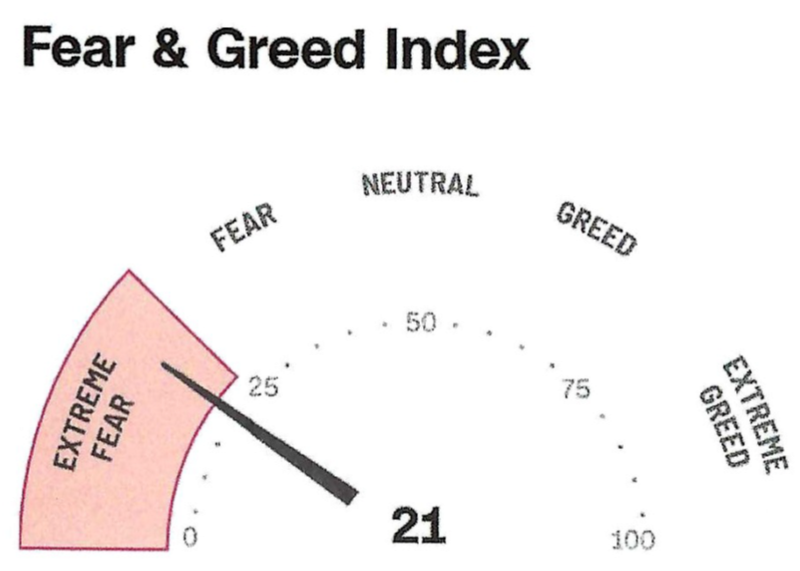
Source: CNN
Also, the American Association of Individual Investors (AAII) survey shows a continuation of many more bears than bulls. Retail investors continue to be afraid or at least cautious.
Investor behavior (not sentiment) is telling us something different. Breadth readings (advancing stocks compared to declining stocks) surged in October. Rather than selling everything, the bounce in breadth suggests investors are rotating within the market rather than getting out of the market. While the weakness in AI stocks has put a damper on the bull market, there are still things to like out there. It is a good sign that the broad market has managed to trade sideways rather than down as AI infrastructure stocks get hit.
AI BOOM ON PAUSE
The peak for the AI boom was just over four months ago on June 22nd. Since that peak, we have seen a complete shift in market leadership. The stocks that led in the first half of 2026 leading up to the peak of the AI boom have been hit hard in the second half, while AI stocks hit hardest in the first half have surged this half. The mean reversion of the last few months has done little damage to the broader market, but for this bull market to make another leg higher, the AI stocks will need to ultimately recover and take out their prior June 22nd highs. After the tech wreck last Friday, those highs are getting farther away.
Within the AI universe, the two most important groups to watch are semis and memory. Both are struggling now. The Philly SOX semiconductor index was down 9% last Friday alone (and down 17.1% for the month of October). And some key mega-cap tech stocks missed on revenue and earnings estimates last week (including Alphabet, Amazon, and Intel). Their stocks were hit hard. Alphabet stock had its worst day ever after reporting earnings. Intel shares had their worst day since 1974.
Now might be a good time to review the AI thesis – the lifeblood of this bull market. Is it still alive? Here is our take:
The AI buildout remains firmly intact, but markets are starting to distinguish between companies that can comfortably finance that growth and those that cannot. At the same time, AI-related capex is becoming increasingly linked to U.S. economic growth and Treasury yields.
Financing, not demand, is the issue. Rising capital costs could slow the buildout. What we are seeing now is a reassessment of financing and returns, not a reckoning for the AI growth story. There are no signs of compute demand slowing.
The bottom line is we have become nervous bulls. The fundamentals of the AI theme are still intact as mentioned above, but we can’t ignore the market action of AI stocks which is cautioning us of potentially more trouble ahead. This is one of the more dramatic net selling periods in tech stocks we have seen in recent years.